

Files
Date of Award
5-2025
Document Type
Thesis
Degree Name
Master of Landscape Architecture
College
Arts and Sciences
Department
Landscape Architecture, Disaster Resiliency & Emergency Management (LADREM)
Faculty Advisor
Dominic Fischer
Studio Coordinator
Jay Kost
Faculty Chair
Dominic Fischer
Publisher
North Dakota State University
Rights
NDSU policy 190.6.2
URI
https://www.ndsu.edu/fileadmin/policy/190.pdf
Abstract
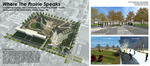
This study assesses prairie restoration success at the Theodore Roosevelt Presidential Library in Medora, North Dakota, using Floristic Quality Assessment (FQA) to compare remnant and restored prairie areas. Emphasizing the use of locally sourced native seeds, the research highlights the importance of genetic diversity and ecological resilience for sustainable restoration. A mixed-methods approach combines ecological surveys across 20 acres with interviews involving landscape architects, ecologists, volunteers and cultivators. Species-specific conservatism values (C values) were used to evaluate habitat quality and ecological integrity. The study advocates adaptive management and ongoing monitoring to support resilient ecosystems. Findings inform a design proposal for Bison Court at North Dakota State University (NDSU) in Fargo, a key campus location surrounded by residence halls and academic buildings. Drawing from ecological insights, the design focuses on creating a welcoming North Gateway and Visitor Entrance, promoting sustainability and education through native plantings and fostering social engagement through inclusive outdoor spaces. The result is a vibrant, educational and ecologically grounded campus landscape.
Recommended Citation
Mou, Jannatul Ferdous, "Where the Prairie Speaks: Connecting Ecology and Community by Integrating Floristic Quality Assessment at the NDSU Prairie Center, Fargo, ND" (2025). Landscape Architecture Theses. 28.
https://digitalcommons.ndsu.edu/landscape-architecture-theses/28
ThesisPresentation_Mou.pdf (21508 kB)
ThesisSupplement_Mou.mp4 (623056 kB)