

Files
Date of Award
2019
Document Type
Thesis
Handle
https://hdl.handle.net/10365/29843
Publisher
North Dakota State University
Rights
Distribution license signed by student (2019) and included as background license document (see bitstream attachments).
URI
https://www.ndsu.edu/fileadmin/policy/190.pdf
Abstract
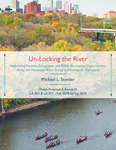
Lock and dam systems harm rivers across America by disrupting their natural processes and destroying their unique riparian ecosystems. Riverbed habitat is covered by sediments, water temperatures rise due to slower flows, and fish can no longer migrate their natural routes. Most lock and dam systems were built to accommodate for industrial uses and barge shipping, but as barge traffic has slowed and maintenance costs of dams has risen the viability of these systems has come under question. The restoration of the Mississippi River Gorge in Minneapolis, Minnesota, will allow for natural processes to return after the removal of two lock and dams on a former stretch of unique whitewater. Restored riparian systems improve ecosystem health, eliminate costs associated with aging dams, and provide new recreational and economic opportunities. This thesis research will provide a blueprint for finding which plant communities can best be used for bank stability and riparian habitat restoration along rivers with removed dams. The research will analyze native and hardy plants to determine site fitness based on factors such as root structure, life span, growth rate, and aesthetics. The project will strive to serve as an example for dam removal projects on the Upper Mississippi and across the Upper Midwest.
Recommended Citation
Stottler, Michael L., "Un-Locking the River: Addressing Riparian Ecosystems and Public Recreation Opportunities Along the Mississippi River Gorge in Minneapolis, Minnesota" (2019). Landscape Architecture Theses. 88.
https://digitalcommons.ndsu.edu/landscape-architecture-theses/88