

Files
Date of Award
2012
Document Type
Thesis
Handle
https://hdl.handle.net/10365/19978
Publisher
North Dakota State University
Rights
NDSU Policy 190.6.2
URI
https://www.ndsu.edu/fileadmin/policy/190.pdf
Abstract
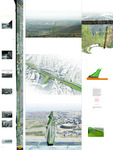
By definition, borders lie on the edges. This project investigates the spatial implications of politically defined borders, and the effects that these materializations have in the context of urban space and the movement through and/or around them. Borderwalk transforms the border into a center, and creates junctures rather than limits. It resurrects the forgotten landscape held captive between the two existing border walls and elevates it. It is served by a light rail transit system and introduces multiple new crossing points, it seeks to facilitate movement and dialogue. It creates space for binational farmer’s markets, youth sports, and community gardens. It is a place for families and friends separated by the border. Globalization has created a multitude of new boundaries, both physical, and abstract, which require contemporary architecture to develop a more comprehensive and integrated spatial, social, and politcal consciousness if it intends to be a relevant voice in future conversations.
Recommended Citation
Kuster, Kristopher, "Borderwalk: Spatial Politics and Cultural Intimacies on the U.S.-Mexican Border" (2012). Architecture Theses. 160.
https://digitalcommons.ndsu.edu/architecture-theses/160