

Files
Date of Award
2023
Document Type
Thesis
Handle
https://hdl.handle.net/10365/33188
College
Arts, Humanities, and Social Sciences
Department
Architecture
Faculty Advisor
Urness, Cindy
Publisher
North Dakota State University
Rights
NDSU policy 190.6.2
URI
https://www.ndsu.edu/fileadmin/policy/190.pdf
Abstract
The typology of this thesis is centered around Architectural Environments within commercial office buildings. The theoretical premise is based on the statement that people are less productive when their work environment is cold, artificially lit, and has limits to pattern and nature. This premise brings up the challenges that the workforce has and will continue to have since the Covid-19 pandemic. How can architects design environments (external, internal, intimate, etc) with the opportunity to positively impact the productivity and marketability of people, investors, and their work places. Can Architectural Environments have a direct positive impact on productivity? How can we as designers retrofit vacant and under-utilized commercial office buildings into clever, thoughtful, and pattern-driven architectural environments that will not only benefit our economy’s new style of remote work, but also provide employees and communities with useful spaces that will set them up for their optimal form of work/life productivity? To aid in solving these challenges, a book of design patterns that reflect results in productivity and marketability will be produced. The research strategies used in this thesis are historical research, qualitative data research, and other combined strategies.
Recommended Citation
Jordheim, Lexi Cheyenne, "Retrofitting Architectural Environments in Response to an Evolving Workplace" (2023). Architecture Theses. 1606.
https://digitalcommons.ndsu.edu/architecture-theses/1606
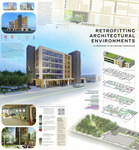
Thesis Display_Jordheimm.JPG (3318 kB)
Thesis Presentation_Jordheim.pdf (53664 kB)
Thesis Supplement01_Jordheim.pdf (187 kB)
Thesis Supplement02_Jordheim.pdf (56038 kB)