

Date of Award
5-2025
Document Type
Thesis
Degree Name
Master of Architecture
College
Arts and Sciences
Department
Architecture
Faculty Advisor
Ganapathy Mahalingam
Studio Coordinator
Stephen Wischer
Faculty Chair
Susan Kliman
Publisher
North Dakota State University
Rights
NDSU policy 190.6.2
URI
https://www.ndsu.edu/fileadmin/policy/190.pdf
Abstract
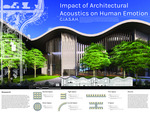
People are subjected to a variety of soundscapes that may cause stress or limit recovery after a stressful event. It is important to find exactly what causes these stressors in the built environment so they can be eliminated. This study explores and categorizes the effects that different simulated acoustic spaces have on the emotions of the participants of the study. These simulated spaces are all designed to test a different architectural element. Change in emotion was measured with a mixture of biometrics and emotional survey data. Biometric data collected heart rate and electrodermal activity, both measurements of change in emotion.. The results showed that there was an emotional change while the participants listened to the simulated spaces. Spaces that were more associated with positive emotions all blocked the direct signal from the source and did not allow for much reverberation. Spaces that were more negative in their emotional impact all had small volume spaces that did not block direct signals.
Recommended Citation
Reber, Robert, "Impact of Architectural Acoustics on Human Emotion" (2025). Architecture Theses. 25.
https://digitalcommons.ndsu.edu/architecture-theses/25