

Date of Award
2021
Document Type
Thesis
Handle
https://hdl.handle.net/10365/32893
Publisher
North Dakota State University
Rights
NDSU policy 190.6.2
URI
https://www.ndsu.edu/fileadmin/policy/190.pdf
Abstract
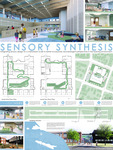
Autism Spectrum disorder, ASD, is a developmental disability caused by differences in the brain. It results in social, communication, behavior, and emotional differences. Since ASD is a spectrum there is a large range in the learning, thinking, and processing abilities of individuals who are affected by it. Sensory sensitivity is a common symptom of ASD, and triggers for it can be impacted by the built environment. All children deserve the chance to learn in an environment that is well suited to them, to do so with their peers, and to be equipped for a future that lives up to their full potential. The focus of this thesis is on the implementation of sensory design in mainstream schools. Specifically, by looking at how Autism Spectrum Disorder impacts the brain differently from a ‘neurotypical’ individual, the study will delve into how spaces have been designed to limit sensory overload and allow individuals with ASD the freedom to thrive. Implications of designing for individuals with ASD on those without the disorder will be evaluated to see how sensory strategies can be beneficial to all of the space’s users. The major question is whether the recent design strategies of sensory sensitive design can be transcribed back into a ‘typical’ school so that facilities can be utilized harmoniously, fostering relationships between currently separate groups?
Recommended Citation
Reimer, Olivia, "Sensory Synthesis: Exploring the Integration of Sensory Design in Early Education" (2021). Architecture Theses. 420.
https://digitalcommons.ndsu.edu/architecture-theses/420