

Date of Award
2022
Document Type
Thesis
Handle
https://hdl.handle.net/10365/32912
Publisher
North Dakota State University
Rights
NDSU policy 190.6.2
URI
https://www.ndsu.edu/fileadmin/policy/190.pdf
Abstract
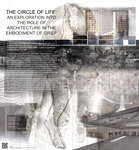
If it is true that we understand ourselves through the other, is it possible that a piece of ourselves is therefore within the other? How has distancing ourselves from the death of others impacted the understanding of the self? Once an essential part of the public realm, death has been increasingly reduced to an efficient process in our modern economic lives. With it has faded away our participation in the symbolic and ritualistic acts that ensured the reciprocal influence of the dead on the living. In their absence, we have gained an aversion which has generated a distance in the connection to one another, and from a piece of ourselves. Considering the underrepresentation of death in modern cities, this thesis examines the role of architecture in the experience of the bereaved by opening a space for active remembrance; an effort to continue the life of one being inside the other, through a continued presence of memory. By employing Federica Goffi’s assertions on memory and fragments, the Hart Island Archives aim to serve as a “corporeal time machine”. Here, mnemic architecture opens an opportunity for the retelling of a tale, and the recombination of the exquisite corpse which is Hart Island.
Recommended Citation
Barta, Ashton, "The Circle of Life: The Role of Architecture in the Embodiment of Grief" (2022). Architecture Theses. 427.
https://digitalcommons.ndsu.edu/architecture-theses/427