

Files
Date of Award
5-2026
Document Type
Thesis
Degree Name
Master of Architecture
College
Arts and Sciences
Department
Architecture
Faculty Advisor
Charlott Greub
Studio Coordinator
Stephen Wischer
Faculty Chair
Susan Kliman
Publisher
North Dakota State University
Rights
NDSU policy 190.6.2
URI
https://www.ndsu.edu/fileadmin/policy/190.pdf
Abstract
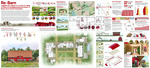
Across rural landscapes, agricultural buildings are increasingly left vacant as farming practices evolve, while a growing senior population remains in homes ill-equipped to support aging, often facing challenges with daily needs, health, and social connection as younger generations leave for urban areas. These underutilized farmsteads present an opportunity to support multigenerational living through the reuse of existing structures, allowing families to remain rooted while adapting to changing needs. This thesis explores how rethinking agricultural buildings can sustain social and physical continuity, drawing on research into adaptive reuse, aging in place, multigenerational households, and rural living. It proposes design strategies on a farmstead near Oriska, North Dakota, including accessibility updates to the farmhouse, a connected home for a younger generation, and renovation of the barn to support family gatherings. Together, these interventions establish a multigenerational framework that supports aging in place, informal caregiving, and long-term adaptability across similar rural contexts.
Recommended Citation
Eggermont, Jared, "Re-Barn: Adaptive Barn Reuse as a Model for Aging in Place and Multigenerational Living on a Rural North Dakota Farmstead" (2026). Architecture Theses. 59.
https://digitalcommons.ndsu.edu/architecture-theses/59
ThesisPresentation_Eggermont.pdf (48036 kB)
ThesisSupplement_Eggermont.mp4 (2590407 kB)