

Files
Date of Award
5-2026
Document Type
Thesis
Degree Name
Master of Architecture
College
Arts and Sciences
Department
Architecture
Faculty Advisor
Ganapathy Mahalingam
Studio Coordinator
Stephen Wischer
Faculty Chair
Susan Kliman
Publisher
North Dakota State University
Rights
NDSU policy 190.6.2
URI
https://www.ndsu.edu/fileadmin/policy/190.pdf
Abstract
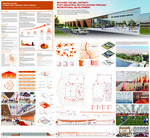
Transforming post-industrial cities through recreational development examines how medium-sized communities can transition from declining industries to new economic identities by expanding sports and recreation infrastructure. Centered on Sartell, Minnesota, this study addresses the civic and economic void left behind from the destruction of the Verso Paper Mill in 2012. Using the “research by design” method utilizes qualitative analysis, a community-focused survey, and case studies showing how a hybrid sports complex can function as an economic engine and replace a community’s lost identity. The findings show that these facilities activate “sports-led regeneration” by attracting regional engagement, generating annual economic impact while fostering social capital through creating shared third places. By integrating multifunctional athletic spaces with accessible community spaces, this thesis provides a strategic manual for urban renewal based on the three core pillars: economic sustainability, social cohesion, and physical environmental renewal. This framework offers a model for transforming post-industrial cities with a new active civic anchor.
Recommended Citation
Frisbie, Kylee, "Reviving the Mill District: Post-Industrial Revitalization Through Recreational Development" (2026). Architecture Theses. 70.
https://digitalcommons.ndsu.edu/architecture-theses/70