

Files
Date of Award
5-2026
Document Type
Thesis
Degree Name
Master of Architecture
College
Arts and Sciences
Department
Architecture
Faculty Advisor
Ganapathy Mahalingam
Studio Coordinator
Stephen Wischer
Faculty Chair
Susan Kliman
Publisher
North Dakota State University
Rights
NDSU policy 190.6.2
URI
https://www.ndsu.edu/fileadmin/policy/190.pdf
Abstract
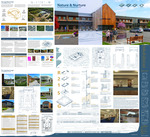
Current specialized care facilities often prioritize functionality over the emotional and psychological well-being of their residents. For individuals experiencing dementia, illegible architectural layouts hinder spatial problem-solving and cause severe disorientation. This thesis introduces "Nature & Nurture," a comprehensive dementia recovery and research community proposed for Duluth, Minnesota. By utilizing Kevin Lynch’s Five Elements of the cognitive image, this project establishes an evidence-based architectural framework designed to reduce cognitive load. The design integrates multi-sensory wayfinding cues, continuous circulation paths, and hyper-local landmarks to facilitate environmental recognition rather than demanding complex memory recall. Ultimately, this thesis demonstrates how legible spatial design can act as a physical prosthesis for damaged memory, enabling residents to safely maintain their autonomy, activity, and identity.
Recommended Citation
Hardy, Treyton, "Nature and Nurture: The Cognitive Image of a Building and Its Site" (2026). Architecture Theses. 72.
https://digitalcommons.ndsu.edu/architecture-theses/72
ThesisPresentation_Hardy.pdf (1557966 kB)
ThesisSupplement_Hardy.pdf (102576 kB)