

Files
Date of Award
5-2026
Document Type
Thesis
Degree Name
Master of Architecture
College
Arts and Sciences
Department
Architecture
Faculty Advisor
Ganapathy Mahalingam
Studio Coordinator
Stephen Wischer
Faculty Chair
Susan Kliman
Publisher
North Dakota State University
Rights
NDSU policy 190.6.2
URI
https://www.ndsu.edu/fileadmin/policy/190.pdf
Abstract
This project synthesizes 2,000 years of architectural theory to establish an ethical framework for integrating artificial intelligence into contemporary design. The research culminates in “The Chandler,” demonstrating how AI can enhance, rather than replace, human-driven spatial and cultural values.
The assertion that human design is inherently superior to artificial intelligence relies on the flawed premise that intuitive leaps outweigh data-driven synthesis. Rather than diminishing the architect’s role, the evolution of AI demands that designers become ethical interpreters who ask the right questions. This project investigates how past architectural theorists, from Vitruvius’s foundational triad to Bruce Allsopp’s humanist return, provide a historical framework for navigating the AI paradigm shift. By analyzing the philosophies of Ruskin, Wright, Le Corbusier, Johnson, and Kahn, this research adapts historical “lamps” into guiding principles for the digital age. These principles ensure that while AI offers integrated, efficient solutions, the human architect retains absolute responsibility for ethical vision, aesthetic intent, and the unmeasurable qualities of space.
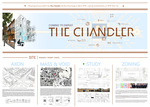
The second phase of this project translates these theoretical findings into practical application through the design of “The Chandler,” a mixed-use building named in honor of the first North Dakota soldier to die in World War I. Throughout The Chandler’s development, various AI tools were integrated into the architectural workflow, acting as collaborative instruments rather than autonomous creators. This applied process demonstrates that new technologies, when built upon proven spatial and sensory principles, align perfectly with enduring architectural values. Ultimately, this work proves that AI will not replace the fundamental human need for connection, memory, and haptic experience; instead, the “good architecture” of tomorrow will rely on technical proficiency strictly guided by human curiosity, reflection, and empathetic care.
Recommended Citation
Laskow, Lucas, "Building on Memory: Towards a Digital Future Informed by Historical Theory" (2026). Architecture Theses. 74.
https://digitalcommons.ndsu.edu/architecture-theses/74