

Files
Date of Award
2023
Document Type
Thesis
Handle
https://hdl.handle.net/10365/33183
Publisher
North Dakota State University
Rights
NDSU policy 190.6.2
URI
https://www.ndsu.edu/fileadmin/policy/190.pdf
Abstract
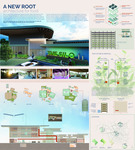
Only 17% of America’s land is considered ideal for agricultural purposes. However, traditional agriculture ruins our land in the long run by depleting the soil of essential nutrients. By conserving the land, we can reap its many benefits. To name a few, conserving the land can play a role in reducing air and water pollution, preserving biodiversity, preventing soil erosion, and can aid in sequestering greenhouse gases. Because land is such a vital resource, we can further preserve it by bringing vertical farming into urban environments. This yields the question: How can architecture be designed for food production to have an impact on the health of people and the environment? The research begins with analyzing several precedent studies of urban agriculture and its implementations within different architecture typologies. The research cumulates in the final design of urban farms designed for several settings, including new and existing markets, a stand-alone structure, and several scales of mixed-use buildings.
Recommended Citation
Gilbertson, Rebekkah R., "A New Root: Architecture for Food" (2023). Architecture Theses. 770.
https://digitalcommons.ndsu.edu/architecture-theses/770