

Files
Date of Award
5-2026
Document Type
Thesis
Degree Name
Master of Architecture
College
Arts and Sciences
Department
Architecture
Faculty Advisor
Ganapathy Mahalingam
Studio Coordinator
Stephen Wischer
Faculty Chair
Susan Kliman
Publisher
North Dakota State University
Rights
NDSU policy 190.6.2
URI
https://www.ndsu.edu/fileadmin/policy/190.pdf
Abstract
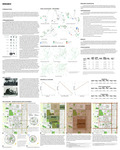
The modern university increasingly faces many challenges such as competition to get and maintain students, relevance in a digital world and beyond. But what if we take a deeper look into how the built environment influences and has potential to improve student success. To do this, we must understand one of the main reasons campuses still exist beyond education, which is community. Most things that can be achieved from a university could be received in a digital format, but human connection is increasingly important. It is important to realize that, through the built environment, we can help empower campus communities.
Furthermore, through an investigation of universities with higher retention rates, a method of analysis of the overall campus community network was developed. Through this analysis, it was found that stronger community networks are often found in universities with higher student success metrics. Taking this information into account, a systematic masterplan concept was developed based on connecting campus entities into community networks. The test site for this concept was the North Dakota State University (NDSU) campus. This proposal takes modern campus needs and combines the needs in such a way that it renews the campus community and thus creates the potential to improve student success in the long term.
Recommended Citation
Wood, Micah L., "Renewal: Connecting the University Campus to Improve Student Success" (2026). Architecture Theses. 81.
https://digitalcommons.ndsu.edu/architecture-theses/81
ThesisPresentation_Wood.pdf (65189 kB)
ThesisSupplement_Wood.pdf (29231 kB)