

Files
Date of Award
5-2026
Document Type
Thesis
Degree Name
Master of Architecture
College
Arts and Sciences
Department
Architecture
Faculty Advisor
Regin Schwaen
Studio Coordinator
Stephen Wischer
Faculty Chair
Susan Kliman
Publisher
North Dakota State University
Rights
NDSU policy 190.6.2
URI
https://www.ndsu.edu/fileadmin/policy/190.pdf
Abstract
This thesis argues that the loss of public life in many contemporary American cities cannot be explained by architecture alone. While placeless, standardized, and emotionally thin architecture remains an important symptom of the problem, the deeper condition is urban: cities and neighborhoods have been reorganized around the private automobile, separated land uses, oversized parking fields, high-speed commercial corridors, and development models that prioritize convenience and efficiency over human scale. The result is an environment where people technically have access to buildings, sidewalks, shops, and roads, but often lack meaningful freedom of choice. Walking, biking, transit, lingering, and informal social life become difficult or unpleasant, while driving becomes the assumed default for nearly every daily activity.
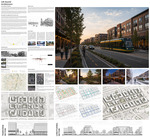
The project studies this condition through the redevelopment of a large car-oriented retail site in Fargo, North Dakota. The existing Walmart and Sam's Club site at 13th Avenue South and 45th Street South represents a familiar pattern in American cities: large single-use buildings, expansive surface parking, disconnected pedestrian routes, and retail pads organized for automobile access. Rather than treating architecture as an isolated object, the thesis proposes the transformation of this site into a walkable Midwestern downtown-style neighborhood composed of mixed-use blocks, internal streets, pedestrian passages, courtyards, public space, local businesses, housing, offices, and reduced dependence on surface parking.
The research combines urban theory, transportation design, public health literature, local Fargo planning context, and comparative case studies to establish a design framework. The project seeks to demonstrate that architecture becomes socially meaningful only when it participates in a larger urban fabric. Life beyond architecture therefore means life supported by streets, squares, public rooms, small businesses, transit choices, local identity, and everyday encounters. The thesis proposes not a rejection of cars or modern life, but a more complete city in which driving is one option among many rather than the condition that organizes all others.
Recommended Citation
Benvenutto, Mauro, "Life Beyond Architecture" (2026). Architecture Theses. 83.
https://digitalcommons.ndsu.edu/architecture-theses/83