

Date of Award
2017
Document Type
Thesis
Handle
https://hdl.handle.net/10365/25990
Publisher
North Dakota State University
Rights
NDSU Policy 190.6.2
URI
https://www.ndsu.edu/fileadmin/policy/190.pdf
Abstract
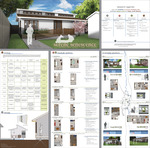
As the population of baby boomers reaches retirement age, the question of how to house and properly care for this generation comes to mind. Many of the smaller living spaces geared toward the senior population are not always designed to address their changing physical, social, and emotional needs. By creating a system of modular spaces to be combined to readily create accessory dwelling units--more commonly known as “granny flats”--on the properties of their children or close friends, these needs are more easily met. The inclusion of universal design principles ensures that these accessory dwelling units are fit to meet the needs of the resident without giving the sterile feeling of a nursing home. Different sized options for each space allows the resident to choose the spaces that fit their specific needs to reduce excess wasted space. By creating a living space on the property of a child or friend, anxiety is reduced for both the senior and their child and the social and emotional bonds between the two are strengthened.
Recommended Citation
Clarksean, Kristin, "Serene Senescence: Modular Aging in Place in Fargo, North Dakota" (2017). Architecture Theses. 846.
https://digitalcommons.ndsu.edu/architecture-theses/846