

Files
Download Full Text (62.1 MB)
Download Final Presentation Qual 5-4-15 - FINAL.pdf (79.5 MB)
Download Qual_FinalBook spreads high.pdf (66.7 MB)
Download Qual_FinalBook.pdf (15.0 MB)
Download Entry perspective digital.png (77.0 MB)
Download ext people.png (101.3 MB)
Download LONG SECTION FINAL 3.png (124.5 MB)
Download looking back.png (70.6 MB)
Download looking out final.png (51.7 MB)
Download The Gem 48-3 print.png (117.8 MB)
Download The Gem stairs final.jpg (10.8 MB)
Download up duct2.jpg (2.1 MB)
Download underwater final2.png (105.0 MB)
Download shortsection FINAL.png (70.0 MB)
Download Thesis Presentation Read Along final Qual.docx (31 KB)
Download DSC02029.JPG (4.9 MB)
Download DSC02033.JPG (5.2 MB)
Download DSC02038.JPG (3.7 MB)
Download DSC02042.JPG (4.9 MB)
Download DSC02048.JPG (4.5 MB)
Download DSC02052.JPG (4.6 MB)
Download DSC02055.JPG (4.6 MB)
Download DSC02060.JPG (4.5 MB)
Download DSC02061.JPG (4.8 MB)
Download DSC02066.JPG (5.0 MB)
Download DSC02062.JPG (4.4 MB)
Download Artefact Photo.png (1.2 MB)
Download Qual_Thesis Video.MP4 (179.5 MB)
Date of Award
2015
Document Type
Thesis
Handle
https://hdl.handle.net/10365/24944
College
Arts, Humanities, and Social Sciences
Department
Architecture & Landscape Architecture
Faculty Advisor
Wischer, Stephen
Publisher
North Dakota State University
Rights
NDSU Policy 190.6.2
Abstract
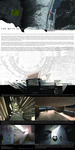
As Hans-Georg Gadamer explains, because modern society is so focused on specialization, medicine and health have become disjointed from common knowledge. Similarly, sustainability is often unrealizable to the users of a building through their experience. This is due to the specialized application of sustainable technology in the form of complex systems. Such issues are important because architecture has always been meaningfully perceived through the lived-experience of the body. In fact, looking to history, one will find that the root of sustain is Sustinere – To Hold. Is it possible to examine sustainability as both an experiential phenomena and a specialist’s application of technology to a building? When Martin Heidegger defined dwelling, he defined it as a means of sustainable discourse as well as a relation of the body to the surrounding world. Located in Georgetown Colorado, the design integrates sustainable technology into the experience of architecture rather than being an applied formulaic system alone. The building, inspired by the wonder of a gem, acts as a bridge between sustainable practices and the body, the world and greater culture, the individual and the cosmos.
Recommended Citation
Qual, Matthew, "The Myth of sustainable culture : The National Museum of Gems, Metals & Minerals" (2015). Architecture Theses. 993.
https://digitalcommons.ndsu.edu/architecture-theses/993
Qual_FinalBook spreads high.pdf (68306 kB)
Qual_FinalBook.pdf (15343 kB)
Entry perspective digital.png (78813 kB)
ext people.png (103683 kB)
LONG SECTION FINAL 3.png (127474 kB)
looking back.png (72329 kB)
looking out final.png (52978 kB)
The Gem 48-3 print.png (120620 kB)
The Gem stairs final.jpg (11084 kB)
up duct2.jpg (2134 kB)
underwater final2.png (107563 kB)
shortsection FINAL.png (71631 kB)
Thesis Presentation Read Along final Qual.docx (31 kB)
DSC02029.JPG (5065 kB)
DSC02033.JPG (5350 kB)
DSC02038.JPG (3759 kB)
DSC02042.JPG (4969 kB)
DSC02048.JPG (4625 kB)
DSC02052.JPG (4703 kB)
DSC02055.JPG (4709 kB)
DSC02060.JPG (4601 kB)
DSC02061.JPG (4881 kB)
DSC02066.JPG (5099 kB)
DSC02062.JPG (4518 kB)
Artefact Photo.png (1183 kB)
Qual_Thesis Video.MP4 (183774 kB)