

Files
Date of Award
5-2026
Document Type
Thesis
Degree Name
Master of Landscape Architecture
College
Arts and Sciences
Department
Landscape Architecture, Disaster Resiliency & Emergency Management (LADREM)
Faculty Advisor
Dominic Fischer
Studio Coordinator
Jay Kost
Faculty Chair
Dominic Fischer
Publisher
North Dakota State University
Rights
NDSU policy 190.6.2
URI
https://www.ndsu.edu/fileadmin/policy/190.pdf
Abstract
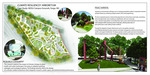
This thesis explores how climate change may influence the severity of Oak Wilt Disease and Dutch Elm Disease in Fargo, North Dakota, and how landscape design can respond to future urban forest health challenges. Urban trees are essential components of green landscapes because they provide shade, aesthetic value, ecological benefits, and social comfort. However, climate change is altering environmental conditions such as temperature, precipitation, soil moisture, humidity, drought, and flooding, all of which can influence plant disease development. This research focuses on two major tree diseases: Oak Wilt Disease, caused by Bretziella fagacearum, and Dutch Elm Disease, caused by Ophiostoma ulmi and Ophiostoma novo-ulmi. Both diseases are influenced by interactions among host trees, pathogens, insect vectors, and environmental conditions. Using a review-based research method, this study examines scientific literature, Fargo tree canopy data, and climate data related to temperature and precipitation trends in North Dakota. The research identifies how warming temperatures, increased precipitation events, and changing insect vector activity may increase disease pressure on elm and oak trees in Fargo’s urban forest. The findings suggest that future climate conditions may create more favorable conditions for disease development and spread, especially if urban tree composition remains limited or overly dependent on vulnerable species. Therefore, increasing tree diversity, improving species distribution, and designing climate-adaptive landscapes are essential strategies for long-term urban forest resilience. The design application translates these research findings into a landscape proposal that promotes tree diversity, ecological resilience, and public education. The project incorporates an arboretum, diverse deciduous and evergreen tree plantings, bioswales, rain gardens, water features, and social gathering spaces. Together, these design strategies create a resilient, educational, and community-centered landscape that responds to climate change while supporting the health and longevity of Fargo’s urban forest.
Recommended Citation
Ghafori Dehgolan, Rojin, "Climate-Adaptive Urban Arboretum: Designing Tree Diversity and Landscape Resilience Against Climate-Related Tree Diseases in Fargo, North Dakota" (2026). Landscape Architecture Theses. 2.
https://digitalcommons.ndsu.edu/landscape-architecture-theses/2
ThesisPresentation_Ghafori.pdf (21337 kB)
ThesisSupplement_Ghafori.mp4 (628951 kB)