

Files
Date of Award
5-2026
Document Type
Thesis
Degree Name
Master of Landscape Architecture
College
Arts and Sciences
Department
Landscape Architecture, Disaster Resiliency & Emergency Management (LADREM)
Faculty Advisor
Dominic Fischer
Studio Coordinator
Jay Kost
Faculty Chair
Dominic Fischer
Publisher
North Dakota State University
Rights
NDSU policy 190.6.2
URI
https://www.ndsu.edu/fileadmin/policy/190.pdf
Abstract
International borders are among the most engineered and ecologically fragmented landscapes in the world. Along the U.S.-Mexico border, infrastructure systems such as walls, patrol roads, and cleared enforcement zones have disrupted wildlife movement, fragmented habitats, altered hydrological systems, and limited social interaction between neighboring communities.
This thesis develops a digital environmental twin framework to evaluate ecological and social connectivity within the San Diego-Tijuana border region. Using ArcGIS Pro and ArcGIS Urban, spatial datasets including land cover, habitat suitability, hydrology, circulation networks, and urban density were analyzed to identify areas with high ecological potential and opportunities for intervention.
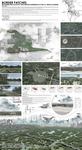
The research informed a site-specific landscape architecture proposal within a 1,400-acre border landscape at San Ysidro-Tijuana. The design reimagines the border as a layered ecological and social infrastructure through habitat restoration, wildlife corridors, wetlands, elevated circulation systems, and controlled cross-border gathering spaces.
Together, the research and design demonstrate how digital environmental tools can support evidence-based landscape strategies that restore connectivity, strengthen biodiversity, and create new forms of interaction within fragmented border environments.
Recommended Citation
Goodarzi, Shima, "Border Patches: Reconnecting Ecology and Human Experiences at the U.S.-Mexico Border" (2026). Landscape Architecture Theses. 3.
https://digitalcommons.ndsu.edu/landscape-architecture-theses/3
ThesisPresentation_Goodarzi.pdf (142564 kB)
ThesisSupplement_Goodarzi.mp4 (1015896 kB)