

Files
Date of Award
5-2026
Document Type
Thesis
Degree Name
Master of Architecture
College
Arts and Sciences
Department
Architecture
Faculty Advisor
Ganapathy Mahalingam
Studio Coordinator
Stephen Wischer
Faculty Chair
Susan Kliman
Publisher
North Dakota State University
Rights
NDSU policy 190.6.2
URI
https://www.ndsu.edu/fileadmin/policy/190.pdf
Abstract
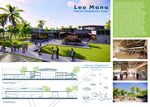
The transition from military to civilian life presents unique challenges for veterans navigating trauma, yet traditional clinical settings often aggravate anxiety and disconnection through sterile, institutional design. This thesis addresses the critical “mismatch” between current healthcare environments and the neurological needs of veterans suffering from Post-Traumatic Stress Disorder (PTSD) and Traumatic Brain Injury (TBI). Arguing that architecture must evolve from a passive vessel to an active therapeutic partner, this research proposes a comprehensive rehabilitation center located on O’ahu, Hawai’i, which integrates the island’s profound cultural connection to the ‘aina (land) with evidence-based design strategies.
The design methodology synthesizes three core frameworks: Trauma-Informed Design (TID), Salutogenesis, and Biophilic Design. Functioning as the facility’s “operating system,” TID prioritizes psychological safety by mitigating hypervigilance through the elimination of environmental triggers, such as blind corners and complex layouts. This is supported by salutogenic principles that aim to rebuild a veteran’s “sense of coherence” and manageability and biophilic strategies that utilize O’ahu’s natural landscape to induce “soft fascination” and restore cognitive resources.
The resulting architectural typology features a “gradient of control,” empowering users to self-regulate social interaction by transitioning between private refuge zones and active community spaces. By employing spatial strategies such as “on-stage/off-stage” circulation and maximizing “prospect and refuge,” the project offers a non-institutional, restorative atmosphere. Ultimately, this thesis establishes a replicable, evidence-based framework for future veteran care facilities, demonstrating how the built environment can actively foster resilience, autonomy, and holistic recovery.
Recommended Citation
Welk, Megan Lyn, "Architecture of Healing Beyond the Institution: A New Model for Veteran Care" (2026). Architecture Theses. 80.
https://digitalcommons.ndsu.edu/architecture-theses/80
ThesisPresentation_Welk.pdf (44134 kB)
ThesisSupplement_Welk.pdf (18861 kB)