









-
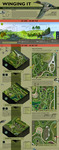
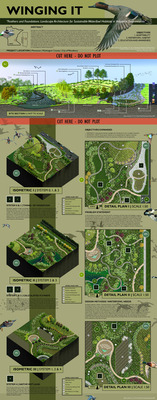
Winging It: Feathers and Foundations: Sustainable Waterfowl Habitats in Industrial Environments
Aftyn Gary Lehman
Development is the lifeblood of Landscape Architecture. Woodbury is the fastest growing city within the state of Minnesota and the need for industrial and commercial areas has quickly increased. Located just 15 minutes East from Saint Paul via Interstate 94, the suburban sprawl has expanded well beyond what any resident thought possible. One site in particular has been chosen to be developed. Within the past 5 years alone, habitat has been quickly lost. Originally, a collection of farm fields and interconnected ecosystems, this land was home to a large population of migratory waterfowl. Since development, this population has been largely displaced and is limited to other habitats. The primary intent of the selected focus area is to reinvigorate lost habitat for these species. This plan will serve as an example of what is possible within an industrial district, while being an attractive feature to a land pillaged by industrial abominations.
-

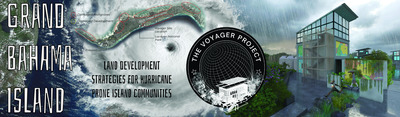
Resilient Land Development Strategies for Hurricane-Prone Communities in Grand Bahama
Garrett Lieberg
This thesis explores resilient, off-grid land development strategies for hurricane-prone communities on Grand Bahama Island, with a focus on post-disaster housing, integrated stormwater management, and mangrove restoration. Designed in response to systemic failures during Hurricane Dorian, this project proposes a decentralized community model supported by modular container homes, solar power, and rainwater harvesting systems. Emphasis is placed on using nature-based solutions—especially the protective role of mangroves—to reduce flood risk and enhance long-term resilience. The site design integrates stormwater retention landscapes with ecological buffers, providing both environmental protection and community benefit. Drawing from interviews, local site conditions, and precedent studies, the final proposal presents practical strategies for sustainable recovery and adaptive living in vulnerable coastal regions.
-
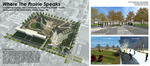
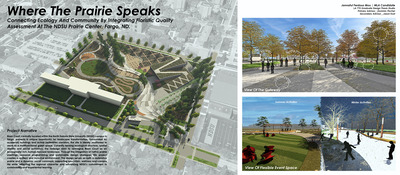
Where the Prairie Speaks: Connecting Ecology and Community by Integrating Floristic Quality Assessment at the NDSU Prairie Center, Fargo, ND
Jannatul Ferdous Mou
This study assesses prairie restoration success at the Theodore Roosevelt Presidential Library in Medora, North Dakota, using Floristic Quality Assessment (FQA) to compare remnant and restored prairie areas. Emphasizing the use of locally sourced native seeds, the research highlights the importance of genetic diversity and ecological resilience for sustainable restoration. A mixed-methods approach combines ecological surveys across 20 acres with interviews involving landscape architects, ecologists, volunteers and cultivators. Species-specific conservatism values (C values) were used to evaluate habitat quality and ecological integrity. The study advocates adaptive management and ongoing monitoring to support resilient ecosystems. Findings inform a design proposal for Bison Court at North Dakota State University (NDSU) in Fargo, a key campus location surrounded by residence halls and academic buildings. Drawing from ecological insights, the design focuses on creating a welcoming North Gateway and Visitor Entrance, promoting sustainability and education through native plantings and fostering social engagement through inclusive outdoor spaces. The result is a vibrant, educational and ecologically grounded campus landscape.
-
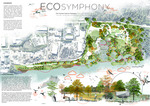
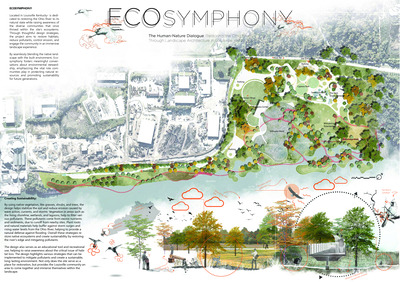
Ecosymphony: The Human-Nature Dialogue: Restoring the Ohio River Through Landscape Architecture in Louisville, Kentucky
Jayden Nadgwick
Riparian areas are delicate ecological zones that support a wide range of ecosystems, that work together to create rich and healthy habitats. Today, these zones are under threat due to pollutants, flooding, and industrial development along riverbanks. The Ohio River, ranked as one of the most endangered rivers in the United States, is a clear example of how these threats impact the health of the rivers. These threats have led to significant habitat loss and declining health of ecosystems, impacting not only the natural environment but also the well-being of surrounding communities.
Based in Louisville, Kentucky, along the Ohio River. This thesis explores design strategies aimed to create sustainability and restoring ecological balance. It investigates how people and nature can respond to each other's needs, ultimately creating harmony between the built and natural environments.
-
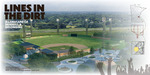
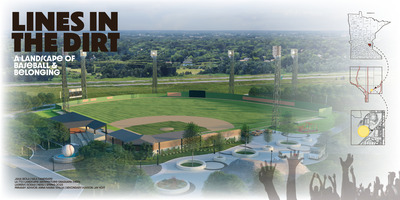
Lines in the Dirt: A Landscape of Baseball and Belonging
Julia S. Riola
This thesis reimagines an underutilized, commercially zoned site in Blaine, Minnesota. Once a drained wetland, the site is positioned between expanding suburbs and smaller surrounding communities. The project proposes a multifunctional public landscape rooted in baseball, ecology, and community connection. A community baseball field serves as the anchor, surrounded by prairie meadows, forest trails, ponds, and gathering spaces that aim to restore ecological systems and social engagement. The design explores how landscape architecture can transform overlooked suburban areas into places of belonging, where community, movement, and nature come together. Through layered programming and sensitivity to context, the project offers a vision for healing land and community alike.
Printing is not supported at the primary Gallery Thumbnail page. Please first navigate to a specific Image before printing.